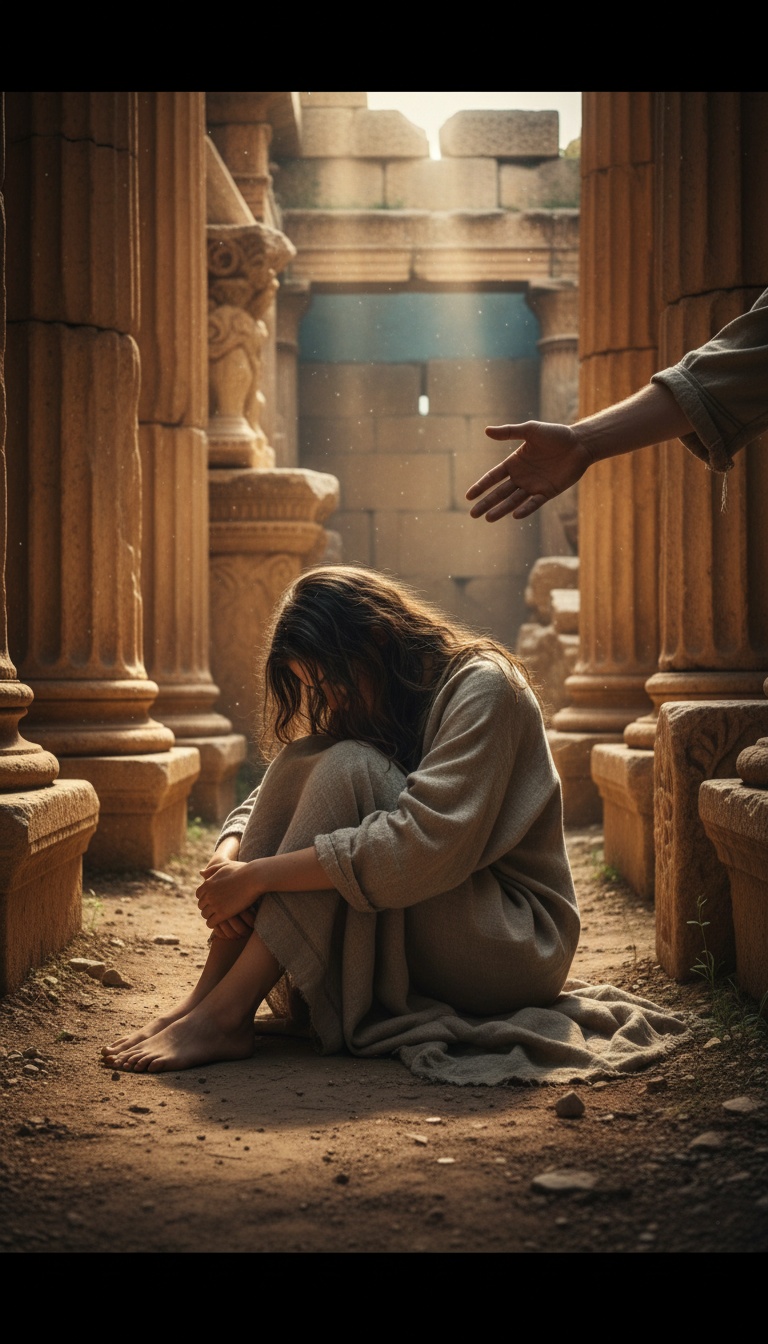
This narrative explores the intersection of religious judgment and radical grace[cite: 207]. Dragged to the Temple floor, the woman is used as a political pawn to trap Jesus[cite: 207]. Her situation highlights the hypocrisy of those who hold the gavel for others' sins while hiding their own[cite: 207]. When Jesus stoops to write in the dust, He shifts the focus from her guilt to the accusers' own conscience[cite: 207]. He doesn't condone the sin, but He offers a "caught by Mercy" moment, transforming her from a target of stone to a recipient of life[cite: 207].
Associated Scripture
John 8:7: "And as they continued to ask him, he stood up and said to them, 'Let him who is without sin among you be the first to throw a stone at her.'"
John 8:10-11: "Jesus stood up and said to her, 'Woman, where are they? Has no one condemned you?' She said, 'No one, Lord.' And Jesus said, 'Neither do I condemn you; go, and from now on sin no more.'"
Suno Style Prompt: vocal forward, Cinematic Folk-Rock, Soulful, Gritty Female Vocals, 92 BPM, tension-building strings, raw percussion, slow and intentional build, emotional and powerful
Lyrics
[Verse 1]
The sun was barely breaking over the eastern wall
When they dragged me to the center,
Waiting for the fall
I was caught in the shadows, caught in the act
With the weight of the Law like a whip on my back
They didn't see a woman, they didn't see a soul
Just a target for the anger they couldn't control
[Chorus]
I was caught by the fire, caught by the shame
Caught by the people who whispered my name
But then I was caught by the One who was holy
Who didn't demand that I tell Him my story
When I deserved the stone, He gave me His hand
And I was caught by a Grace I don't understand
[Verse 2]
The stones were so heavy, but the silence was more
As He stooped to the ground on that Temple floor
I waited for lightning, I waited for death
But He just looked down
And He held back His breath
Then one by one, I heard the rocks hit the sand
As the only One sinless stayed holding my hand
[Bridge]
We want the gavel for the neighbor's sin
But we want the door closed when the light walks in
He wrote the truth down deep in the sand
And the stones of judgment fell from their hand
I was caught in the act, yeah, I was guilty as charged
But the only One sinless let me walk free and large
[Chorus]
I was caught by the fire, caught by the shame
Caught by the people who whispered my name
But then I was caught by the One who was holy
Who didn't demand that I tell Him my story
When I deserved the stone, He gave me His hand
And I was caught by a Grace I don't understand
[Outro]
No one left to stone me...
No one left to judge...
In the dust and the mud
I was caught... by Mercy